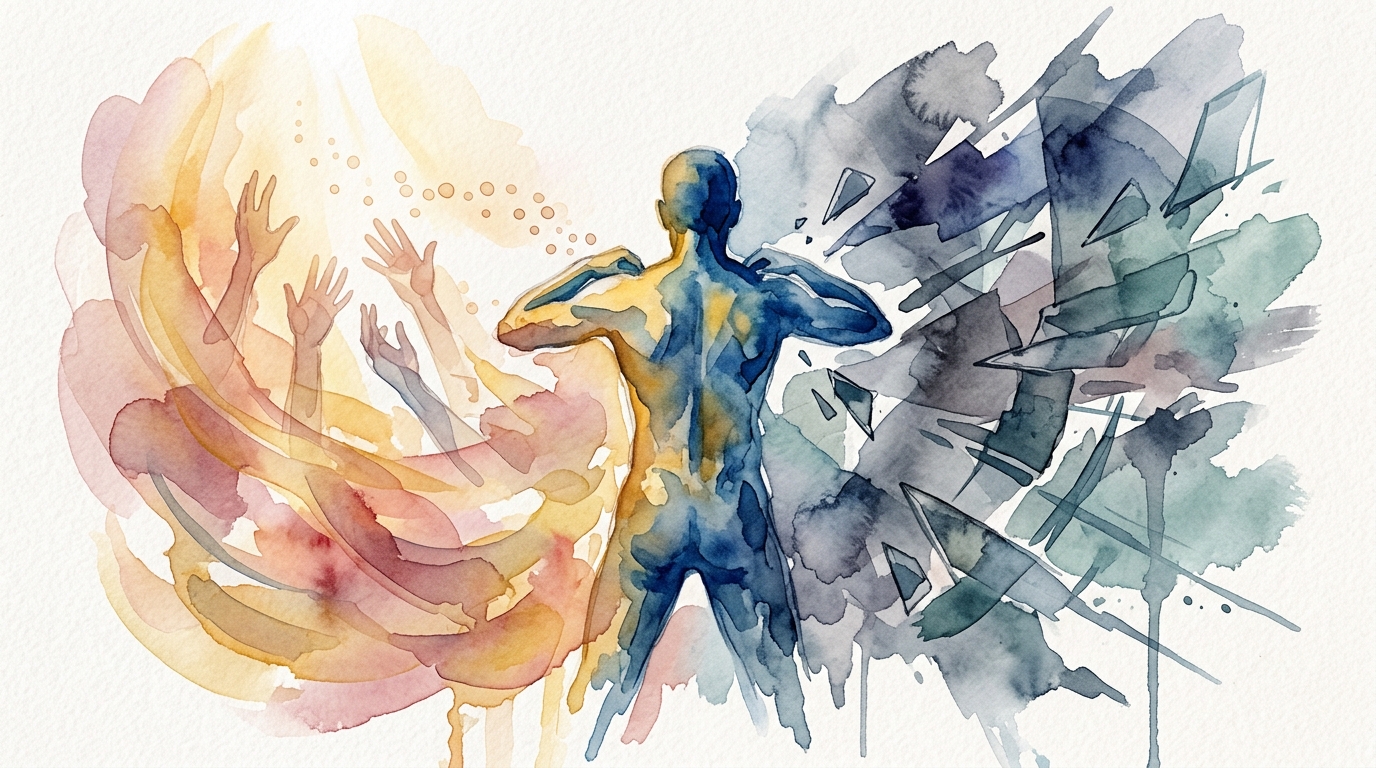
Picture this: you've been dating someone for four months, and the relationship feels like a weather system you can't predict. Some evenings, they're warm, open, almost urgent in how much they want to be close to you. Then something small happens — a canceled plan, a tone that read as cold in a text — and they're suddenly distant, defensive, or furious in a way that seems completely out of proportion. You try to repair it. Sometimes they let you in. Other times they push harder away. And when you finally get close again, the relief is overwhelming — until the next storm.
You've probably heard the phrase 'attachment issues.' But if someone described this person to a therapist, the answer wouldn't be simply 'anxious' or 'avoidant.' It would likely point toward something more complex: a disorganized attachment style.
This pattern is mentioned frequently in relationship content, usually in a single paragraph tucked after the more famous styles. But it deserves a much longer conversation — because it's the most frequently misread, most often dismissed as 'just their personality,' and the most painful to be on either side of.
Why Disorganized Attachment Is the Hardest Style to Recognize
Most people learn about attachment theory through a neat framework: secure, anxious, avoidant. These three styles have recognizable signatures. Anxious partners tend to seek reassurance and fear abandonment. Avoidant partners tend to pull back when things get emotionally intense. Both styles have a coherent strategy — a consistent way of managing closeness and distance.
Disorganized attachment doesn't.
That's actually the clinical definition. Researchers Mary Main and Judith Solomon first identified this pattern in 1986 when studying infants who didn't fit neatly into the existing attachment categories. These children showed contradictory behaviors — approaching their caregiver while simultaneously leaning away, freezing mid-motion, displaying fear of the very person they were turning to for comfort. Main and Solomon called it 'disorganized/disoriented' attachment precisely because there was no organized strategy.
In adults, this absence of a coherent strategy is what makes the pattern so easy to misread. It doesn't look like consistent anxiety or consistent withdrawal. It looks like both, sometimes within the same conversation. And because it's inconsistent, partners often label it as manipulation, emotional instability, or simply 'drama' — none of which capture what's actually happening.
Understanding how attachment styles shape the way partners respond to each other is the foundation for making sense of any of this, but disorganized attachment requires an extra layer of nuance that most general overviews don't provide.
Where Disorganized Attachment Comes From
The Role of Childhood Trauma and Unpredictable Caregiving
Disorganized attachment is strongly associated with childhood trauma — particularly experiences of abuse, neglect, or chronic emotional unpredictability from primary caregivers. Studies suggest that disorganized attachment is present in roughly 80% of children who have been maltreated, compared to approximately 15% of the general population.
But 'trauma' here doesn't always mean dramatic, obvious abuse. It can also mean a caregiver who was loving sometimes and terrifying other times. A parent who was present when sober and completely different when not. A parent whose own unresolved trauma caused them to dissociate, rage, or collapse without warning. The common thread isn't the specific event — it's the experience of not being able to predict whether closeness brings safety or danger.
Why the Caregiver Becomes Both Safe Haven and Source of Fear
Here's where it gets neurologically complex. Every child is biologically wired to turn toward their caregiver under stress. That's not a choice — it's a survival mechanism. But when the caregiver is also the source of the stress, the child's nervous system faces an impossible equation: the thing I need to survive is also the thing that hurts me.
This creates what researchers call 'fear without solution.' The child can't approach (dangerous) and can't avoid (biologically impossible to suppress attachment seeking). So the system fragments. There is no strategy because no strategy works.
In adulthood, that same dynamic gets activated in intimate relationships — because intimate relationships are, fundamentally, where we re-experience our earliest attachment patterns. The person who becomes closest to us also becomes the person our nervous system is most confused about.
What Disorganized Attachment Looks Like in Adult Relationships
The Push-Pull Pattern: Wanting Closeness and Fearing It Simultaneously
The most visible signature of disorganized attachment in adults is the push-pull dynamic. And it's worth being precise here, because 'push-pull' gets used loosely to describe all sorts of relationship behavior.
In disorganized attachment specifically, the push and the pull are happening at the same time. It's not that the person wants closeness on Monday and distance on Friday. It's that they want closeness and are terrified of it in the same moment. What you observe externally — the back-and-forth, the approach-then-retreat — is the behavioral expression of two competing internal drives that cannot resolve each other.
So they might initiate deep emotional conversations and then suddenly shut down. They might be physically affectionate and then seem almost dissociated immediately after. They might tell you they love you in the same breath as telling you they don't deserve you. These aren't mixed signals sent strategically. They're genuine — and that's what makes them so confusing.
Emotional Dysregulation and Relationship Conflict
Another hallmark of disorganized attachment is emotional dysregulation — responses to relational triggers that seem disproportionate to what actually happened. A partner forgets to text back and the reaction is hours of withdrawal or a full argument. A slightly dismissive tone lands like a devastating rejection. Plans change last minute and it triggers what looks like a crisis.
This isn't an overreaction to the present situation. It's a reaction to what the present situation represents — what the nervous system has learned to anticipate. When your early experiences taught you that distance means abandonment and closeness means danger, your threat-detection system calibrates accordingly. A small trigger can set off a large alarm because the alarm isn't measuring this moment. It's measuring every similar moment from the past.
This is also why conflict with a disorganized attachment partner can feel almost impossible to resolve. The conversation might start about one thing and rapidly expand, escalate, or collapse into shutdown. The person may not be able to stay regulated enough to work through a disagreement — not because they don't want to, but because their nervous system genuinely can't hold that level of emotional activation without fragmenting.
How Disorganized Attachment Differs From Anxious or Avoidant
If you've already explored anxious vs avoidant attachment in relationships, you'll notice some surface-level similarities. Disorganized attachment can look anxious when the person is clinging and seeking reassurance. It can look avoidant when they're shutting down and pulling away. The difference is the pattern's consistency.
Anxious attachment has a strategy: seek proximity, increase attachment behavior, protest separation. Avoidant attachment has a strategy: minimize need, increase self-sufficiency, suppress attachment signals. Disorganized attachment has neither — and switches between the two in ways that feel random, because to the person experiencing it, it often is random. They're not choosing a strategy. They're being thrown between competing impulses.
| Anxious | Avoidant | Disorganized | |
|---|---|---|---|
| Core fear | Abandonment | Engulfment | Both simultaneously |
| Response to closeness | Seeks more | Withdraws | Inconsistent — approach and flee |
| Response to conflict | Escalates, pursues | Shuts down, distances | Escalates then collapses, or freezes |
| Coherence of strategy | Consistent | Consistent | Absent |
| Most common misread | 'Needy' | 'Cold' | 'Dramatic' or 'manipulative' |
Signs Your Partner (or You) May Have a Disorganized Attachment Style
Recognizing this pattern requires looking for a cluster of behaviors, not a single sign. Here's what actually shows up:
- Contradictory relationship behavior — saying they want commitment while simultaneously sabotaging it
- Intense fear of both abandonment and engulfment — feeling trapped when close, terrified when distant
- Dissociation during emotional conversations — going blank, seeming to 'leave' the interaction mentally
- Disproportionate reactions to perceived rejection — small things landing as catastrophic
- Difficulty staying present during conflict — escalating rapidly or shutting down completely
- Shame spirals after vulnerability — opening up and then immediately pulling back, sometimes with anger
- A history of relationships described as 'chaotic' or 'intense' — often on both sides
- Difficulty trusting positive experiences — waiting for the other shoe to drop when things are going well
If several of these resonate, it's worth going deeper. The questions to ask your boyfriend about his past and emotional patterns can help open a conversation that surfaces these dynamics without putting either person on the defensive.
How Disorganized Attachment Affects Intimacy and Trust
Intimacy requires a baseline assumption: that closeness is safe. For someone with disorganized attachment, that baseline was never established. Which means every step toward genuine intimacy activates the exact same threat response that closeness triggered in childhood.
The cruelest irony is that the more meaningful the relationship becomes, the more threatening it feels. A casual relationship might be manageable — stakes are low, so the nervous system doesn't fully engage its defenses. But a serious relationship? One where real vulnerability is possible? That's when the disorganized attachment pattern fully activates.
Trust, similarly, is not a concept that computes easily. Trust requires believing that someone's intentions are stable — that they'll be the same person tomorrow as they are today. When your formative experience of a trusted person was radical unpredictability, your working model of 'trustworthy person' is built on contradictory data. You want to believe the person in front of you. Your nervous system keeps preparing you for the version of them that hurt you.
This is also why people with disorganized attachment sometimes self-sabotage at the point when a relationship is going well. It's not a conscious decision. It's the nervous system anticipating pain and trying to control when it arrives.
Can Disorganized Attachment Be Healed in a Relationship?
Yes — and this matters to say clearly, because disorganized attachment can sound like a life sentence when you read enough clinical descriptions of it. But healing is genuinely possible, and it happens through a combination of professional support and relational experience.
What Therapy Approaches Actually Help
Not all therapy is equally effective for disorganized attachment. Talk therapy alone often falls short, because disorganized attachment is stored in the body and nervous system — not just in narrative memory. The most evidence-supported approaches include:
EMDR therapy (Eye Movement Desensitization and Reprocessing) — Originally developed for PTSD, EMDR has strong research support for processing traumatic memories that drive attachment dysregulation. It works on the stored emotional charge of early experiences, not just the cognitive story about them.
Attachment-focused therapy — Therapists trained specifically in attachment theory can help clients develop what's called 'earned secure attachment' — security that comes from processing and integrating early experiences rather than having had them go smoothly.
Somatic therapy — Because disorganized attachment involves nervous system dysregulation, approaches that work directly with the body (breath, movement, sensory awareness) can reach what purely cognitive approaches can't.
If you want to understand the full spectrum of what recovery can look like, the article on building a secure attachment style in a relationship offers a realistic picture of what 'earned security' actually involves.
What You Can Do as a Partner Without Becoming a Therapist
Look, this part is important — and it's where a lot of partners go wrong. You cannot heal someone's disorganized attachment. That's not a limitation on your love or your effort. It's just not how this works. Trying to function as a therapist in your relationship will exhaust you and ultimately won't serve your partner either.
What you can do:
- Be consistent — Not perfect, but predictable. Follow through on what you say. Show up the same way repeatedly. Consistency is the antidote to the unpredictability that created this pattern.
- Don't escalate during their escalation — If you can stay regulated while they're dysregulated, you become a co-regulating presence. This is genuinely helpful and doesn't require you to be a therapist.
- Name your intentions clearly — Don't assume they can read your motivations. State them. 'I'm pulling back for a minute because I need to think, not because I'm done with this conversation.'
- Encourage professional support — Gently and without ultimatum. Healing happens in therapy. Your relationship can be a place of practice, not a substitute for it.
You might also explore some of the serious questions to ask your boyfriend that open space for this kind of honest conversation without it feeling like an interrogation.
Conversations Worth Having If You Suspect Disorganized Attachment
One of the hardest things about disorganized attachment is that the very conversations that could help — about history, about fear, about patterns — are also the conversations that feel most threatening to have. Vulnerability is both desperately needed and deeply frightening.
But the conversation doesn't have to start with 'I think you have disorganized attachment.' (Please don't start there.) It can start with curiosity. With questions about what felt safe and what didn't in their childhood. About what 'closeness' felt like growing up. About what happens inside them when they feel like someone is pulling away.
The goal isn't diagnosis. It's understanding. And understanding — genuine, patient, non-judgmental understanding — is actually one of the few things a partner can offer that directly supports the healing process.
If you're not sure where to start, thinking about what questions to ask your boyfriend about his past and emotional patterns is a practical entry point. The attachment styles test to identify your style can also be something you do together — not as a label-assigning exercise, but as a way to open language around experiences that often don't have words yet.
Disorganized attachment is not a character flaw. It's not manipulation. It's not 'too much.' It's a survival system that made sense once and now causes suffering. Understanding that distinction — really understanding it, not just intellectually but in how you respond to your partner in hard moments — is where the real work begins.