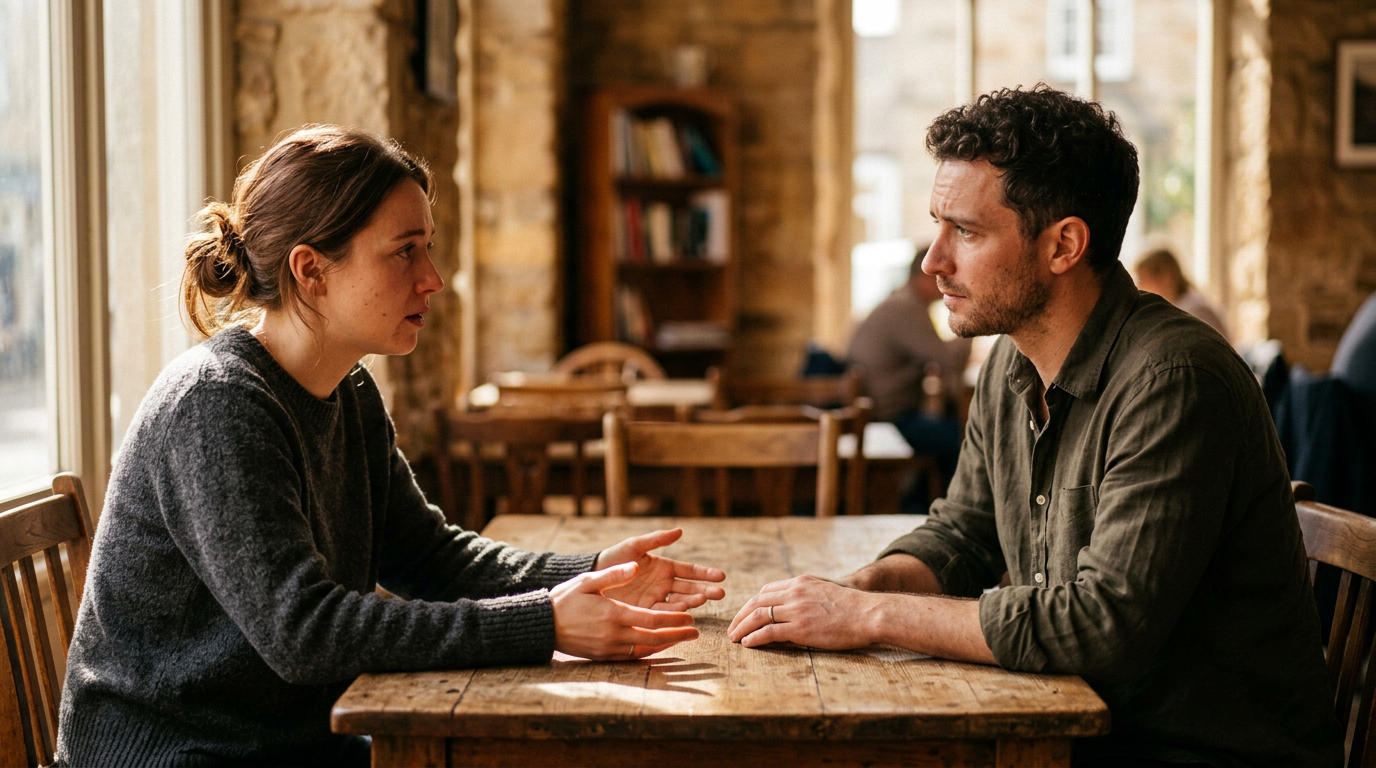
You've probably had the money talk. Maybe even the kids talk. You've discussed where you want to live, whether you want a big wedding, and who does the dishes. And you looked at each other and thought: we're good.
But here's the thing — most couples who end up in a divorce attorney's office also had those conversations. The gap isn't in the logistics. It's in the depth.
The deep questions before getting engaged are the ones that feel a little uncomfortable to ask. The ones where you're not sure what answer you're hoping for. The ones that require both of you to be honest in ways that feel risky. And they're almost universally skipped — not because couples are lazy, but because nobody tells them these questions exist.
This isn't another checklist. It's a framework for the conversations that actually matter.
Why Surface-Level Conversations Aren't Enough Before Engagement
There's a reason most pre-engagement conversations stay in the shallow end. It feels safer there. You're both excited, you're in love, and asking 'what are your unresolved childhood wounds?' feels like a mood killer. So instead, you talk about timelines and apartments and whether his mom will be too involved in the wedding planning.
The problem is that surface-level compatibility is easy to manufacture. Two people can agree on where to live, how many kids to have, and how to split finances — and still be fundamentally misaligned in the ways that matter most. The Gottman Institute, which has studied thousands of couples over decades, consistently finds that it's not the big disagreements that sink marriages. It's the persistent, low-grade misalignment in values, communication patterns, and unspoken expectations.
And those things only surface when you ask the right questions.
Before you even start these conversations with your partner, it's worth reviewing the questions you should be able to answer before you say yes — because some of these you need to answer alone first.
Questions About Your Core Values and Life Vision
Do You Share the Same Definition of a Good Life?
This sounds philosophical. It is. And that's exactly why couples skip it.
A 'good life' means wildly different things to different people. For one person, it's stability, community, and roots. For another, it's freedom, adventure, and reinvention every few years. Neither is wrong. But if you're wired for one and your partner is wired for the other, you're going to spend a lot of years quietly resenting each other's version of happiness.
So ask it directly: What does a good life look like to you in 20 years? Not just the surface stuff — the house, the career, the vacations. The texture of daily life. Do they want a big social circle or a quiet home? Do they want to be deeply embedded in a community, or do they value independence above belonging? Do they see life as something to optimize or something to experience?
The goal isn't to find a perfect match. It's to know where the gaps are before they become grievances.
How Do You Each Define Success — and Does It Align?
Success is one of those words everyone uses and almost nobody defines. And it will show up constantly in your marriage — in career decisions, in how you spend money, in how you parent, in how you measure whether your life is 'working.'
If your partner defines success as professional achievement and status, and you define it as presence and simplicity, that tension will eventually surface. Not in a fight about success specifically — but in a thousand smaller fights about priorities, time, and what you're both working toward.
Ask: What would make you feel like your life was a success? And then listen past the first answer, because the first answer is usually the socially acceptable one. The real answer comes in the follow-up.
This kind of values alignment conversation is exactly what makes questions to ask your boyfriend before getting serious so useful as a starting point — it's not about interrogating someone, it's about understanding how they see the world.
Questions About Faith, Family, and the Things People Avoid Discussing
Religion, Spirituality, and How You'll Raise Children
Religion is the conversation couples either have too shallowly ('we're both kind of spiritual, it'll be fine') or not at all. And then they have kids, and suddenly it's not fine.
The question isn't just 'are you religious?' It's: What role does faith play in how you make decisions? How do you want to handle religious milestones with kids — baptism, bar mitzvahs, confirmation? What happens if one of us becomes more devout, or less?
These aren't hypotheticals. They're real forks in the road that couples hit, often unprepared. Interfaith relationships can work beautifully — but only when both partners have genuinely thought through what they're willing to navigate together. Premarital counseling often surfaces exactly these conversations in a structured way, which is one reason therapists recommend it even for couples who feel 'totally aligned.'
Extended Family Roles and Boundaries
You're not just marrying a person. You're marrying their family's patterns, their family's expectations, and their family's history. That's not cynicism — it's just true.
The questions here go beyond 'do you like my parents.' They're: How much influence should our families have over our decisions? What happens when a parent is sick and needs care — and what does that look like practically? Are there family members whose presence in our life is non-negotiable for you? Are there any whose presence is non-negotiable for me?
And critically: What are the boundaries you'll hold with your family of origin once we're married? Because if someone has never set a boundary with their parents, they probably won't start after the wedding. That's not a character flaw — it's a pattern that needs to be understood before it becomes a recurring conflict.
Questions About Fear, Vulnerability, and What You're Both Afraid Of
What Scares You About Marriage Specifically?
This is one of the most revealing questions you can ask — and almost nobody asks it.
Fear about marriage isn't a red flag. It's human. But the content of that fear tells you a lot. Are they afraid of losing independence? Of repeating their parents' patterns? Of being truly known and then rejected? Of the permanence? Of their own capacity to stay?
When you both answer this honestly, you stop performing confidence you don't fully feel, and you start actually connecting. It also surfaces things that might need work — not as dealbreakers, but as information. Someone who's afraid of repeating their parents' divorce might benefit from premarital counseling. Someone who's afraid of losing themselves in a relationship might need to talk about what autonomy looks like inside your marriage.
You can find more frameworks for this kind of honest conversation in pieces like What Happens to a Relationship When You Actually Ask the Hard Questions — because the dynamic shifts when you go here together.
What Unresolved Issues Are You Bringing Into This?
Everyone brings something into a marriage. Old wounds, old patterns, unfinished grief, the way they learned to fight or to shut down or to disappear. The question isn't whether you have baggage — it's whether you've looked at it.
So ask each other: What's the thing from your past that you think will most show up in this relationship? What are you still working on? What do you need me to understand about how your history shaped you?
This isn't therapy (though therapy helps). It's just honesty. And it creates a foundation where, when patterns do show up — because they will — you're not blindsided. You have context. You have compassion. You have a map.
Questions About Your Relationship With Yourself
Are You Choosing This From Wholeness or From Need?
This one's for you, not your partner.
Are you saying yes because you genuinely want to build a life with this specific person — or because you're afraid of being alone, afraid of starting over, afraid of what people will think if you're still not engaged at 32? Are you choosing this because it feels right, or because it feels safe?
I think this is the question most people avoid most aggressively, because the honest answer can be uncomfortable. And I'm not saying that fear or need disqualifies a relationship — but it should be conscious. You should know which parts of your 'yes' come from love and which come from fear, because those two motivations will show up very differently over a 30-year marriage.
Emotional readiness for marriage isn't about being perfect or fully healed. It's about being honest enough with yourself to know what you're actually bringing to this commitment.
Ask yourself: If I knew I'd be completely fine on my own, would I still choose this? If the answer is a clear yes, that's a good sign. If you need a minute to think about it, that's worth sitting with.
How to Actually Have These Conversations Without It Feeling Like an Interview
Okay, so you've got a list of heavy questions. Now what — do you sit across from each other with a notepad and start firing?
Please don't.
The best versions of these conversations happen sideways — on a long drive, during a walk, in the quiet after dinner when neither of you is rushed. They happen when one person shares something vulnerable first, which gives the other person permission to do the same. They're not interrogations. They're invitations.
A few things that actually help:
Start with yourself. Instead of 'what are you afraid of about marriage,' try 'I've been thinking about what scares me about this step, and I realized it's X. What about you?' Vulnerability leads vulnerability.
Don't expect one conversation. These topics aren't meant to be resolved in a single sitting. They're threads you pull on over time. Start a conversation, let it breathe, come back to it.
Use premarital counseling as a container. A good therapist or counselor creates the structure for exactly these conversations without it feeling like an audit. The Gottman Institute's research-backed approach to premarital work, for example, specifically focuses on surfacing the deeper patterns — not just the logistics. It's not about fixing problems. It's about understanding each other more completely.
Know that discomfort is normal. These conversations are supposed to feel a little exposing. That's the point. If everything feels perfectly easy and breezy, you might not be going deep enough.
For couples who want a structured starting point, exploring what Reddit users identify as the hardest pre-engagement questions can be surprisingly useful — it surfaces the questions real couples wish they'd asked.
What the Answers Tell You — and What Silence Tells You More
Here's the table that actually matters:
| What You Observe | What It Might Mean |
|---|---|
| Partner engages openly, even when uncomfortable | High emotional availability — they can be present for hard things |
| Partner deflects with humor every time it gets real | Avoidance pattern — worth noting, worth naming |
| Partner gets defensive when asked about unresolved issues | Possible shame or unprocessed material — not a dealbreaker, but a flag |
| Partner asks you the same questions back | Genuine curiosity and mutuality — this is what you want |
| Partner has clearly thought about these things before | Self-awareness — a strong indicator of long-term compatibility |
| Partner shuts down entirely | Emotional unavailability — this needs direct attention before engagement |
Look, the answers to these questions matter. But the way someone engages with the questions matters just as much. A partner who doesn't have perfect answers but is genuinely trying to understand themselves and connect with you? That's the person you want. A partner who has polished answers but isn't actually present in the conversation? Worth paying attention to.
Silence — the uncomfortable, 'I don't want to go there' kind — is information. It doesn't automatically mean something is wrong. But it means something is there, and it's worth understanding what.
For couples who want to compare what these conversations look like against structured premarital work, pre-engagement questions vs. premarital counseling breaks down how both approaches serve different but complementary purposes.
And if you're wondering whether you're asking the right questions — not just the deep ones, but the ones specifically suited to where you are in your relationship — romantic questions before marriage and getting engaged covers the territory with a slightly different lens.
What to Do Next
You don't have to have all of these conversations this weekend. But pick one. Start with the one that feels most relevant — or most avoided.
Ask about fear. Ask about what a good life looks like. Ask yourself, quietly, whether you're choosing from wholeness. And notice what happens in the conversation — not just what's said, but how it feels to go there together.
Because the couples who do this work before the ring? They're not the ones who had the easiest conversations. They're the ones who were willing to have the hard ones — and found out they could.